(c) 2017 by Paulo H Leocadio. All rights reserved
THE THERMODYNAMICS OF HELL:
A SCIENTIFIC INQUIRY INTO THE INFERNO
BY
PAULO H LEOCADIO
DISSERTATION
Submitted in partial fulfillment of the requirements
for the degree of Doctor of Philosophy in Fantasy and the Occult
in the Graduate College of the
University of Coruscant at the Fobosi District, Cosuscant
Fobosi District, Coruscant
Introduction: The Law of Hell’s Temperature
Hell is often depicted as the ultimate burning torment in religious texts, but how hot is it, really? Contrary to popular belief, Hell’s temperature isn’t a matter of ancient myth or blind faith — it’s an intriguing scientific puzzle just begging for a little thermodynamic love. For millennia, theologians, mystics, and priests have offered vague descriptions, but with a modern perspective, we can start calculating the infernal temperature based on scriptural references and scientific principles. This chapter seeks to determine the temperature of Hell with a meticulous approach, leveraging biblical, Qur’anic, and apocryphal texts, while introducing thermodynamics as our guiding tool.
The Moon, the Sun, and Heaven’s Radiation (But What About Hell?)
According to Isaiah 30:26, Heaven gets more radiation than a summer day in the Sahara. We calculate Heaven’s temperature (525°C) based on the combined radiative powers of the Sun and Moon — similar to a vacation spot in the surface. However, our focus is Hell, not Heaven. What can we deduce from the scriptures about its temperature? By examining scriptural passages across different religious texts, we seek to uncover the exact nature of this fiery realm, not just through symbolic language, but through detailed thermodynamic analysis.
Chapter 1: The Torah – The Talmudic View – The First Glimpse of Hell
The Torah, a key text in the Jewish tradition, lays the foundation for many of the later ideas found in the Christian and Islamic scriptures. While it does not directly describe Hell as we think of it today, it hints at it with Sheol and Gehenna. The key references we need to examine include:
- Sheol: Often seen as the place of the dead, but not necessarily a place of torment. It’s important to note that Sheol isn’t the fiery Hell we often think of today, but it sets the groundwork for later ideas of Hell as a place of darkness and separation.
- Gehenna: A valley in Jerusalem associated with burning refuse and sacrifices, Gehenna becomes linked with eternal punishment. It is in the later rabbinic literature that Gehenna starts to take on more ominous, fiery connotations.
Thermodynamic Considerations: In terms of temperature, Gehenna (and later interpretations of Hell) would require fire that burns eternally—presumably with sulfur. Let’s speculate that the temperature must be at least 444.6°C (the boiling point of sulfur) for it to exist as a lake of molten brimstone.
Chapter 2: The Old Testament – The Emerging Fire of Damnation
The Old Testament solidifies the foundation for Hell with its vivid descriptions of divine retribution. Notably, Isaiah introduces the concept of fire associated with judgment, while Daniel and Malachi describe a “lake of fire” that burns forever. The key passages we examine are:
- Isaiah 66:24: “And they shall go forth, and look upon the carcasses of the men that have transgressed against me: for their worm shall not die, neither shall their fire be quenched; and they shall be an abhorring unto all flesh.” This verse implies eternal fire—a fire that burns indefinitely and is not extinguished.
- Malachi 4:1: “For, behold, the day cometh, that shall burn as an oven; and all the proud, yea, and all that do wickedly, shall be stubble: and the day that cometh shall burn them up, saith the Lord of hosts, that it shall leave them neither root nor branch.” This points to a high heat—a cleansing, purifying fire.
Thermodynamic Considerations: Using the Stefan-Boltzmann law (which describes the radiative power of black bodies), we can calculate a temperature for Hell based on these descriptions. A fire that “never goes out” would need to sustain itself indefinitely at a high temperature, likely between 800°C-1000°C, in order to burn through all substances and keep its energy flowing continuously.
Hell is a literal place (e.g. Matthew 5:29-30; 10:28). It is a literal place where literal people suffer the torment of a literal fire (e.g. Luke 16:19-31). Its location is down (Proverbs 15:24; Isaiah 14:9; Ezekiel 31:15-17; 2 Peter 2:4). Its temperature is burning hot (Luke 16:24; Revelation 19:20). Its luminance is “outer darkness” (Matthew 8:12; 22:13; 25:30), also called “the blackness of darkness” (2 Peter 2:17; Jude 13). Its size is so massive it is never filled to capacity (Proverbs 27:20), though masses of people are in it and numbers more are added continually (Matthew 7:13-14; Romans 1:18). Its smoke will ascend forever (Revelation 14:11). Its fire will never be quenched, and the worm there will never die (Isaiah 66:24; Mark 9:43-46, 48).
Chapter 3: The New Testament – The Finality of Hell
The New Testament builds upon the Old Testament’s vision of Hell, especially in the Gospels and Revelation, where the concept of eternal fire becomes more defined. Jesus’ warnings of “Gehenna” and the Book of Revelation provide the most detailed insights.
- Matthew 25:41: “Then shall he say also unto them on the left hand, Depart from me, ye cursed, into everlasting fire, prepared for the devil and his angels.”
- Revelation 20:14-15: “And death and hell were cast into the lake of fire. This is the second death.” This fiery lake is described as a place of torment, where the dead are cast and burn eternally.
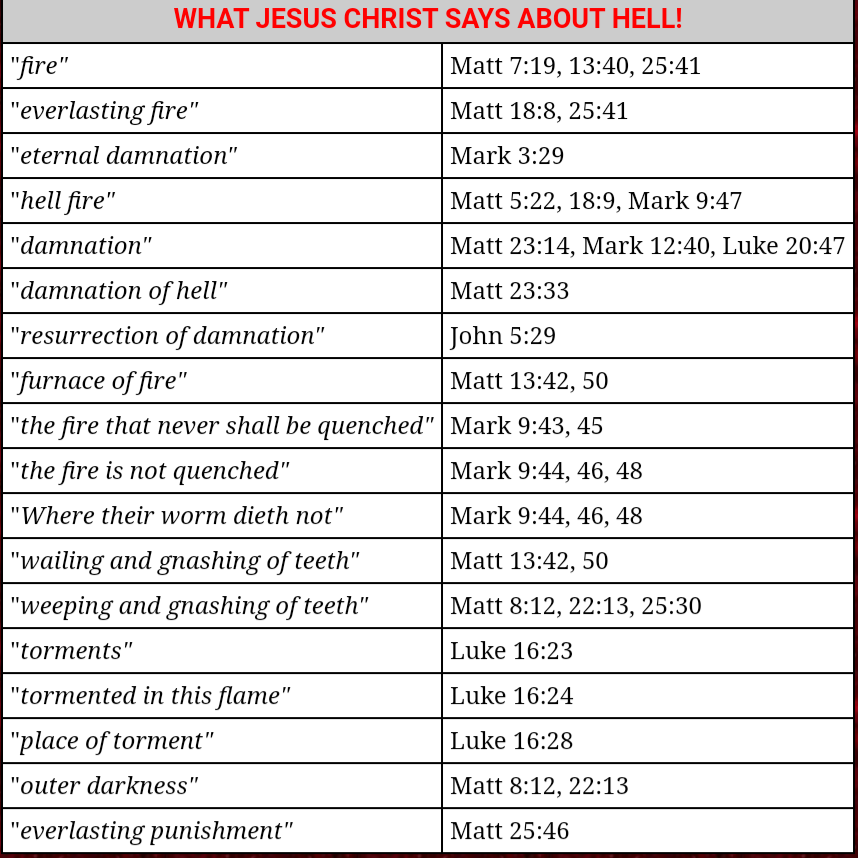
Revelations 21:8 – “But the fearful, and unbelieving … shall have their part in the lake which burneth with fire and brimstone.”
A lake of molten brimstone means that its temperature must be at or below the boiling point, 444.6C. We have, then, that Heaven, at 525C is hotter than Hell at 445C.
Thermodynamic Considerations: Revelation provides an image of a fiery lake, not dissimilar to the inferno of molten brimstone. The temperature here is likely consistent with the earlier descriptions—perhaps even higher—depending on the torment depicted. The thermodynamic consequences of such eternal fire would be catastrophic. Heat would need to be constantly generated to keep the flames burning for eternity, which suggests an energy input equivalent to the energy output of several nuclear reactors.
Chapter 4: The Qur’an – Hell’s Fire in the Islamic Tradition
The Qur’an presents a vivid description of Hell (Jahannam) as a blazing fire that is hotter than any earthly flame. Passages such as:
- Surah 104:5: “But he will be burned in a Fire of Blazing Flame.”
- Surah 66:6: “O you who have believed, protect yourselves and your families from a Fire whose fuel is people and stones, over which are angels, harsh and severe…”
The Qur’an speaks of Hell’s torment as something that not only burns but consumes the damned in every sense of the word. The concept of a fire that burns eternally is central, with physical, spiritual, and psychological dimensions.
HELL. The place of torment is most frequently spoken of in the Qur’an and Traditions as an-Nar, “the fire,” but the word Jahannam occurs about thirty times. It is said to have seven portals or divisions. Surah xv. 44: “Verily, hell (juhannam) is promised to all together (who follow Satan). It has seven portals, and at every door there is a separate party of them.”
Thermodynamic Considerations: Islamic texts describing “blazing flames” suggest temperatures far exceeding the 1000°C mark, perhaps nearing the 2000°C threshold of certain industrial flames, making Hell not just a metaphorical space but a fiery, inescapable prison of unimaginable heat. The flames of Jahannam would need to be consistent with such descriptions—sustained, powerful, and all-encompassing.
Chapter 5: Apocryphal Texts – The Hidden Fire of Hell
The Apocrypha—those sacred writings not included in the canonical Bible—offers additional, and often more graphic, insights into Hell’s fiery nature. For example:
- The Apocalypse of Peter (one of the Christian apocryphal texts) describes Hell in excruciating detail, showing different levels of suffering and specific punishments for various sins. The flames described here are relentless, with a variety of tortures that include being burned alive, yet never perishing.
The Apocalypse of Peter
This apocryphal text offers vivid descriptions of hell, where the damned experience intense, individualized punishments. We could link the temperature of these infernal regions to different energetic states – like molecular motion or energy exchanges – because each soul experiences different temperatures based on their sins.
Quote from The Apocalypse of Peter “And I saw the souls of sinners being burned with fire, each being punished according to the sin they committed. Those who were murderers were burned with flames hot as the sun, while those who were idolaters experienced being engulfed by a vast river of molten gold.”
Here, you could play with the idea that sins are directly proportional to the level of energy expended in their “punishment.” The more “intense” the sin, the hotter the temperature.
The Book of Enoch
In Enoch, the fiery abyss is a common metaphor for punishment, described in vivid and rather fantastical terms. The work speaks about “chains of darkness” where the wicked are bound to remain until the final judgment. In a speculative thermodynamic context, this could be used to explore the “permanent heat” and “pressure” that sinners face, aligning with the idea of “unchanging” physical states in a system of eternal damnation.
QuoteEnoch: “And the fiery abyss is the place of the eternal judgment. It is filled with eternal fire and brimstone, where those who led mankind astray are bound in chains of darkness forever.”
We can scientifically argue that the lack of entropy (the chaos of hell) could be its most defining feature: no matter what happens, the energy (heat) in hell never dissipates; it remains concentrated in an eternal loop of torment, perhaps some divine thermodynamic “cycle,” where the temperature increases infinitely in a confined space. This would explain the eternal burning with no relief.
The Gospel of Thomas
The Gospel of Thomas is another fascinating apocryphal text. Its mystical nature doesn’t focus on hell per se, but it can be interpreted through the lens of spiritual heating (the metaphorical ‘flame of desire’). Perhaps we can think of hell as an arena where souls are continually “burning” with unrequited desires or unattainable goals.
Quote from The Gospel of Thomas: “If you bring forth what is within you, what you have will save you. If you do not bring forth what is within you, what you do not bring forth will destroy you.”
This can show us how “unfulfilled potential” contributes to an infinite buildup of heat and energy, essentially trapping the soul in an eternal state of “unresolved tension.” The unfulfilled soul becomes the “burning ember” in a vast, cosmic furnace.
Thermodynamic Considerations: The Apocryphal texts emphasize not just the heat of Hell but the way it operates in stages, like an industrial furnace with multiple zones of varying intensities. Some areas burn hotter than others, suggesting temperature gradients akin to those found in a blast furnace, where the hottest parts exceed 2000°C.
Conclusion: The Temperature of Hell
By synthesizing the data from sacred texts, we arrive at a fascinating conclusion: Hell, as described in various scriptures, is a realm of fire hotter than any earthly flame. The Bible, the Qur’an, and apocryphal texts all point to a blazing, eternal fire, with temperatures ranging from 800°C to over 2000°C depending on the depth and punishment described. While these texts may not offer precise thermodynamic formulas, the imagery is unmistakably consistent: Hell is not just a place of suffering, it is a place of unrelenting, all-consuming heat, far exceeding the temperatures we encounter in our world.
The exact temperature of Hell might never be fully understood. Still, these religious and theological texts provide a sufficient, if speculative, foundation for thinking about Hell as a real, burning place. The scientific principles applied here — based on ancient scriptures and modern thermodynamics — offer a unique perspective on the temperature of the afterlife.
 The Misfits Pair
Leave a comment