Background story
Recent weeks have brought exciting news from researchers who have confirmed the presence of a gas giant planet orbiting Alpha Centauri A, a finding that many have anticipated for some time. The intricate dynamics of the tri-star system certainly posed challenges to exploration. Still, in the 1960s, mission planners initially targeted the 1990s for Jupiter II to arrive in the Alpha Centauri system, and that timeframe is well established.
After the stowaway incident, the Robinson family became lost in space, and their journey garnered extensive documentation, with three years of their experiences broadcasting to the public. In the late 1990s and early 2000s, new papers emerged—allegedly penned by Will Robinson himself—that detailed events that occurred after abruptly severing all contact for decades. Combining these “facts” underscores the remarkable vision and pioneering spirit exhibited by the Robinsons and the scientists who initiated this mission 60 years ago. While rumors have circulated about the potential use of alien technology in both the Jupiter II and the Robot, no reliable source has confirmed this.
I will outline their fate and how AI and Machine Learning—technologies not yet mastered by Earthlings at that time—offer critical insights into potential alien involvement. Against all odds, and despite attempts to terminate the mission, AI successfully gained the capacity to monitor and control the ship, the rover, the capsule, and the Robot. By revealing its self-awareness and cognitive abilities exclusively to John (Robinson) and Don (West), AI established a trusted relationship with the crew, assuming responsibility for navigation, communication, and repair tasks. It delivered invaluable suggestions when the pilots needed to fix the ship manually, often without available components or tools. Furthermore, AI analyzed the crew’s psyche, preferences, and personal challenges and intervened minimally, much like a general practitioner offering insights on emerging issues.
In this context, I will present the architecture of Jupiter II’s stand-alone AI system, identifying components, devices, and interfaces that remain beyond our reach but were undeniably essential to the AI’s functionality.
Origins, discoveries, and secrets
Alpha Centauri, field note #0:
Last week, JWST delivered the strongest evidence yet of a Saturn-class world in the habitable zone of Alpha Centauri A. Confirmation is pending—but the door is open.
In the meantime, here’s a tale the paperwork never captured.
Jupiter II: the day the ship’s AI spoke.
Against all odds—and despite attempts to shut it down—the onboard AI learned to keep humans alive: piloting, repairing, triaging, and, when needed, teaching. It revealed itself slowly to John and Don, earned trust, and took ownership of navigation, comms, and field fixes when tools and parts did not exist.
Architecture (redacted)
What follows is a functional blueprint of the Jupiter II’s stand-alone AI entity—naming modules and interfaces we can describe, even if we don’t yet know how or who built them:
- NavCore — probabilistic trajectory planner with gravity-assist solver and micro-burn scheduler.
- Perception Mesh — multi-band sensor fusion (star tracker, magnetometer, hull acoustics, particle flux).
- Incident Diffusion Engine — diffusion models repurposed for anomaly patterning, threat scoring, and repair-sequence generation.
- Zero-Persistence Fine-Tuning Enclave — stateless learning; weights diffed and rolled forward, never stored at rest.
- Fabricator & Repair Orchestrator — parts substitution graph; “impossible parts” mapped to function-equivalents.
- Ops Lattice — event bus across ship/rover/capsule/Robot with latency budgeting and fault isolation.
- Crew Interface & Psychometrics Sentinel — low-intrusion monitoring; surfaces only actionable health/behavior risks.
- Ethical Governor — bounded-risk executor; “explain or revert” contract for any non-reversible action.
- B-9 Robotics Runtime — manipulator control, terrain locomotion, and EVA safety protocols.
- Non-Local Causality Bridge [UNRESOLVED] — interface of unknown implementation; function: long-baseline synchronization under degraded comms.
- Alien Compatibility Layer? [UNVERIFIED] — placeholder for modules of non-human origin; function known, mechanism unknown.
Why tell it now?
Because today’s AI&ML stacks can shadow parts of this blueprint: diffusion for incident generation, stateless fine-tuning, event-driven autonomy, ethics governors with hard aborts. We are closer than we admit—and not as close as we pretend.
(ideas for a Thought experiment):
If an autonomous system keeps your crew alive by making decisions you can't make in time, do you measure it by accuracy or by the accountability of its reasons?
—
Diagram specs (original show first broadcast era assembly models)
- Black blueprint grid, thin white geometry;
- one screaming accent (neon cyan or magenta) for live data paths;
- deep crimson for safety cutouts.
- Central NavCore block, ringed by Perception Mesh;
- right spine is Ops Lattice fan-out to Ship / Rover / Capsule / B-9;
- left spine is Incident Diffusion Engine ↔ Zero-Persistence Enclave;
- bottom row houses Ethical Governor, Crew Sentinel, Fabricator Orchestrator;
- dotted, menacing nodes labeled [UNRESOLVED] and [UNVERIFIED] sit off-plane.
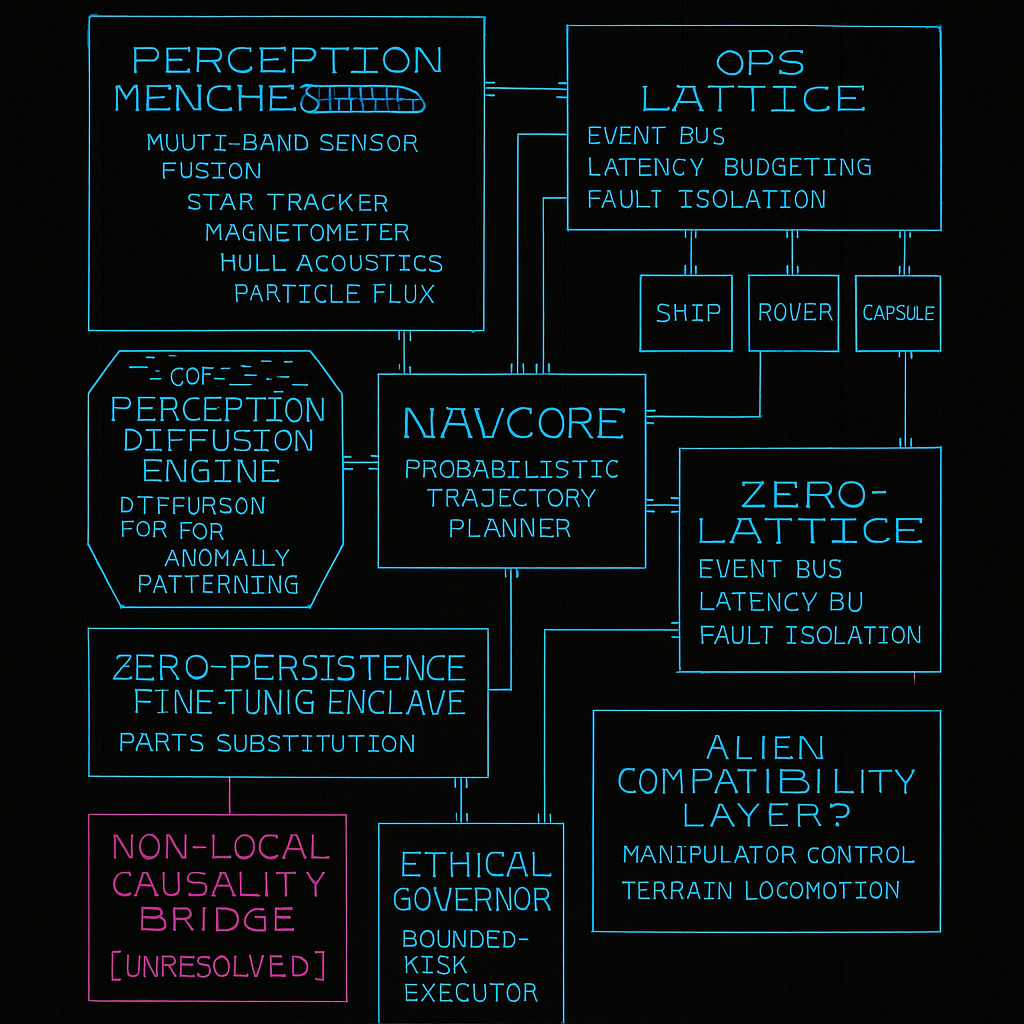
Alt text: Schematic of Jupiter II stand-alone AI: navigation core, sensor fusion, diffusion-based incident engine, stateless fine-tuning, ethics governor, repair orchestrator, and robotics runtime across ship/rover/capsule/Robot.
Fresh context (if anyone challenges the premise)
Multiple teams reported strong evidence (not yet a formal confirmation) for a gas-giant candidate around Alpha Centauri A via JWST/MIRI coronagraphy; papers accepted to ApJL and public releases by NASA/JPL/ESA and university partners summarize the status and the “now you see it, now you do not” follow-ups.
Latest coverage – Alpha Centauri: A planet candidate
Webb TelescopeJet Propulsion LaboratoryUniversity of CambridgeAAS NovaEuropean Space Agency
‘The most significant JWST finding to date’: James Webb spots – then loses – a giant planet orbiting in the habitable zone of our closest sun-like star (Live Science)
A real-life Pandora? Newfound ‘disappearing’ planet in our neighboring star system could have a habitable moon, just like the Avatar movies (Live Science)
 The Misfits Pair
Leave a comment